Daily Diary 2
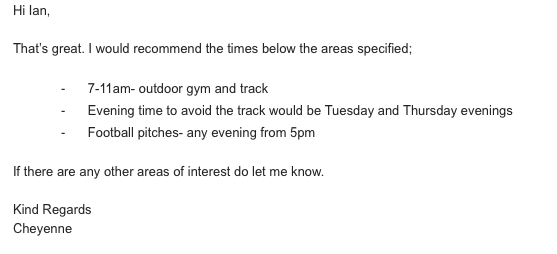
I filmed with my group at Paddington Rec so now we have a lot of footages, the weather was sunny which was the perfect day for us to film as we needed a nice day to film. We did not have a lot of time to film as one of the colleagues was busy and we did not have a lot of people to interview. What I could have done differently was emailed Jade earlier to have more time to film and tell her that we will be needing some people to interview as we did not inform her about that.
Daily Diary 1
Today I made sure I finished all the tasks for Unit 9, there was some things missing for example the budget form. I told my group and we got that done.
We emailed Jade (a colleague from Paddington Rec) to inform her that we will be going there to film our video. 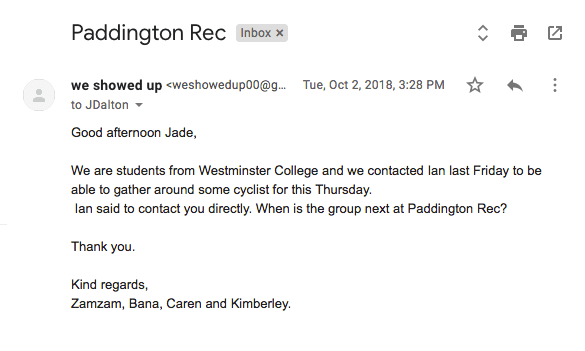
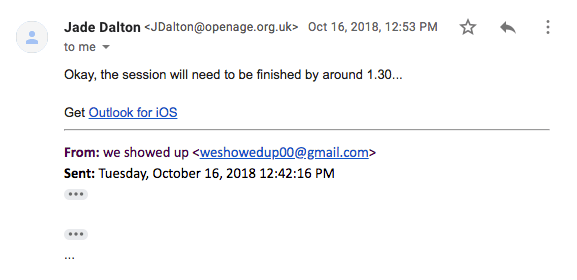
What I could have done differently was to make sure I had all my paperwork done before I started filming as I wasted some time finishing off paper work when I could have been filming some scenes for the video.
Unit 10 // Video Installation Proposal (2.1)
For my video installation, I will be creating a video piece for exhibition in a specific location for an intended target audience which is 15-20 year olds and the theme will be based on memory.
My video installation is called ‘Misunderstood’. I chose this title for my video as I want it to represent the feelings and emotions that is going on throughout the video, it will also make the audience captivated and curious to find out what the video is about as the title does not explain what it will be about.
My video idea is something that some of the audience can relate to as when you watch it, you will instantly be able to figure out the idea behind the video. I was inspired by the artist Bill Viola, and his video called The Encounter:
I will be changing this idea into something else and I will be filming it in a different scene.
My video will be quite emotional and deep for the people that relate to it and even the people that do not. The beginning of the video will be a close up of Kim and the camera will slowly move towards Bana showing their emotions by looking at the floor back to back. To make it effective and emotional, the video will be black and white to show deep/sad feelings and make it seem realistic. I will be however only adding colour to the petals that will be falling on them to show that they are the main focus of that scene.
I will be using the song ‘When the Party is over by Billie Eilish’ but the instrumental version so that the focus will be on the video itself and not the song. It is a sad song which fits in to the video and makes it more effective and builds up the tension and dramatic scenes. My target audience is teenagers and adults (15-20+ year olds), this is because they are more likely to relate and understand the meaning of the video rather than little kids who will not understand. The equipment that I will be using are; Camera and flowers. The flowers will be used to throw over the two actors in slow motion for my video to make it effective and dramatic. I will be using a camera from the college and I will be buying my own flowers.


In conclusion, I would like to produce a video installation that people will be affected by and even may relate to. Also, the purpose of this idea is to make people aware of other peoples emotions and that everyone should be treated equally no matter what.
Unit 10 // Video Installation
Unit 12 // Research and Analysis in Film Practice
I will be clarifying the transition/technological changes in filmmaking from the age of silent cinema to now.
The obvious difference between silent films and today’s films is the absence of sound. A silent film usually involves actors that need to be dramatic by making exaggerated facial expressions and hand gestures. This has now changed as todays actors do not need to depend on non-verbal communication, this is due to the fact that the audience can pick up what is occurring through their words, tone of voice, and mood. There is no dialogue in a silent film so therefore you have to think about what the characters are saying, their thoughts and what they are doing in order to understand the film. On the other hand, films today do all the thinking for us instead and this is because we can see and hear everything that is happening in the film, you only witness the film without having to think about it.
Camera Technology
Ever since it was possible in the 1880s to generate a variety of different images on a transparent filmstrip, there are new ways of taping and arranging them have been made current down the centuries. Today, cameras have permitted clearer videos and images and a variety of different shots that has never crossed our minds. Moreover, with the abstract of the cloud and many different editing apps, producing films have never been easier. Technology has attained black and white films to high definition movies in the film industry, movies that are able to make the audience feel like they are apart of this movie and as if they are there in a very short period of time.
The silent world
Once cinematography had been confirmed, came along some of the best movies from the silent era. Plots that include young innocent victims, wicked villains and unhappy heroes abounded, as did slapstick and comedy. Although these were known as silent movies, technology developments authorised filmmakers to acquaint text screens or titles in between the action in order to better explain the narrative of the story.
Computer-generated imagery
Also known as CGI, back in 1973 the science fiction movie called ‘Westworld’ was the first to use CGI. It was first initially selected in order to produce a two-dimensional interpretation of a robot-cowboy’s field of vision. However in the later years, three-dimensional technology provided effects for both films called Tron (1982) and Futureworld (1976).
Nowadays, films are produced and distributed in a very different way, the internet itself has certainly changed and will continuously change throughout the years. The manner in which movies are observed and distributed, not to mention who makes them and the genres/types of movies you watch. Today, as a result of worldwide distribution and immediate access, all you really need is a telephone to be able to watch any film. There are podcasts, downloading, streaming and web shows so that the consumers have enough power than industry moguls.
Filming
In 1909, aerial shots used an aircraft-mounted camera in order to take a photographs with lots of different shots from the skies. The camera however was very heavy it weighed more than the plane, audiences were always able to see props and sets which creates an unreasonable viewing experience for them. On the other hand, nowadays we have drones that use procedure on filmmaking techniques for example viewing angles, screen position and shot sizes to take a good shot. There are also 3D printed objects which helps interact with actors realistically unlike CGI, also 3D printing that have lead to sets and props which have high quality and resolution as well as easy customisation.
Movie camera – late 1800s
This is a camera that is able to capture a variety of different photographs onto filmstrip in a quick period of time, without it we would have not been able to enjoy watching movies. Regardless of the technical displays of ‘moving images’ back in the late 1800s, it was the Lumiere brothers who persuaded early pioneers such as George Melies who was the first person to add narratives in to moving images. The Lumiere brothers were apart of some of the earliest screenings of projected images back in 1895, this is where their film ‘The Arrival Of A Train At La Ciotat Station’ notably showed a train getting into a station. The audience avoided and ran away from the screen as they though it was real.
There was silent movies way before sound could even be captured simultaneously to picture. This era was especially popular for the acting, live-music accompaniment to films in theatres and the use of titles between shots. The whole procedure of synching sound had been earned with ‘The Photo-Drama Of Creation’ back in 1914, this is when photograph and slides records were synched up however the Warner brothers ‘Vitaphone’ that took the system in order to feature a variety of different films.
Acting and screenwriting both slowly took on a whole new essence and new genres were moulded, and then dialogue became an important key component of films which marks the start to ‘the talkies’.
Colour – 1939 (or 1917)
Colour has changed film for the better although there is nothing wrong with a black and white movie, after the Oscar winner for best film ‘The Artist’ verified that black and white films can still aggravate an emotive experience for todays audiences. Nowadays colour has given the ability to imitate life more realistically than ever before, however it also guided to more narrative possibilities for example ‘The Wizard Of Oz’ (1939) which has notably portrayed Dorothy’s Kansas in black and white and then brought Oz to life in technicolour.
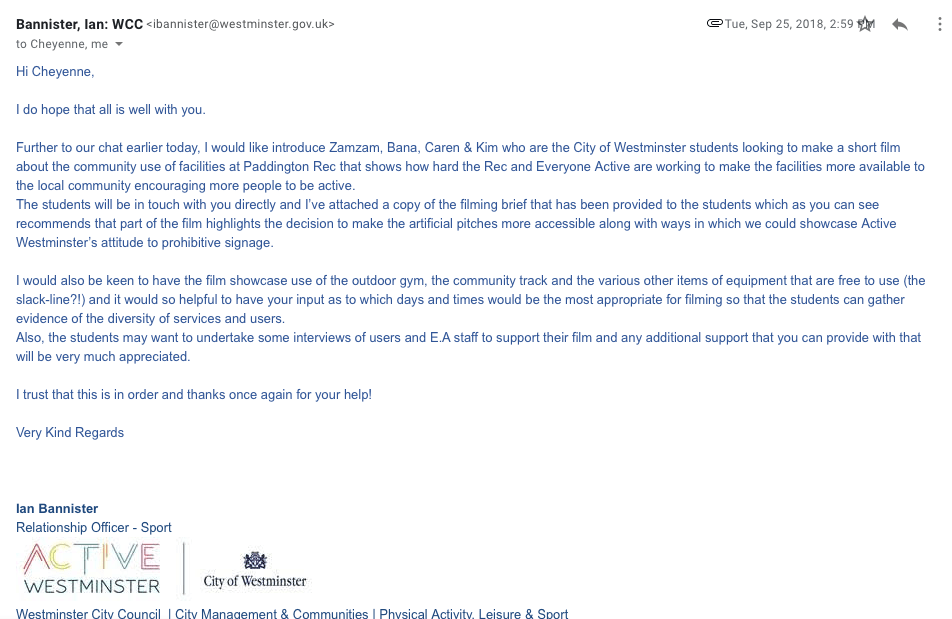
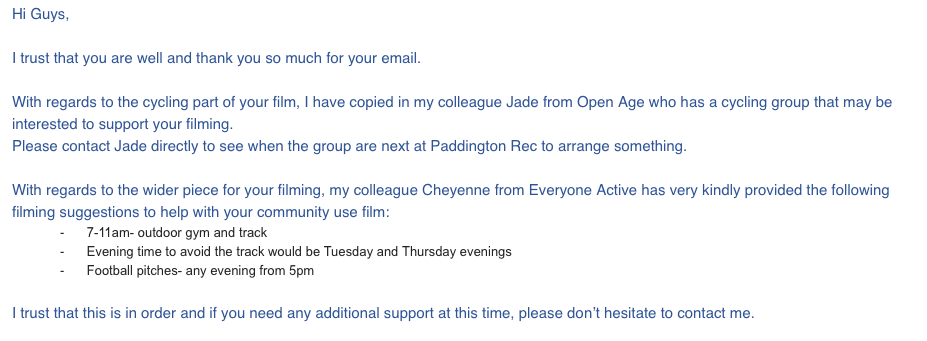
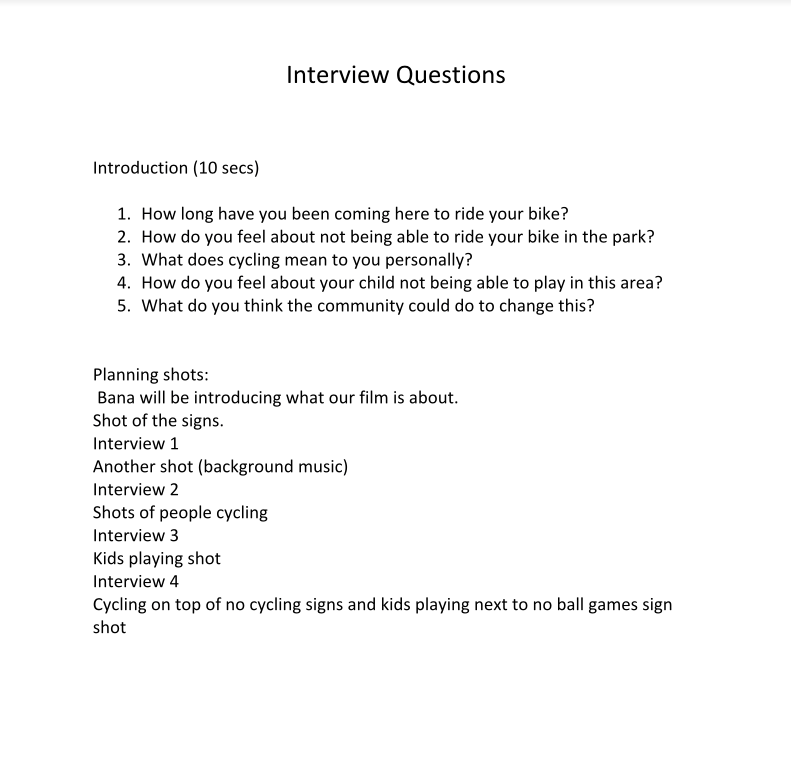
Unit 9 // Clients Feedback
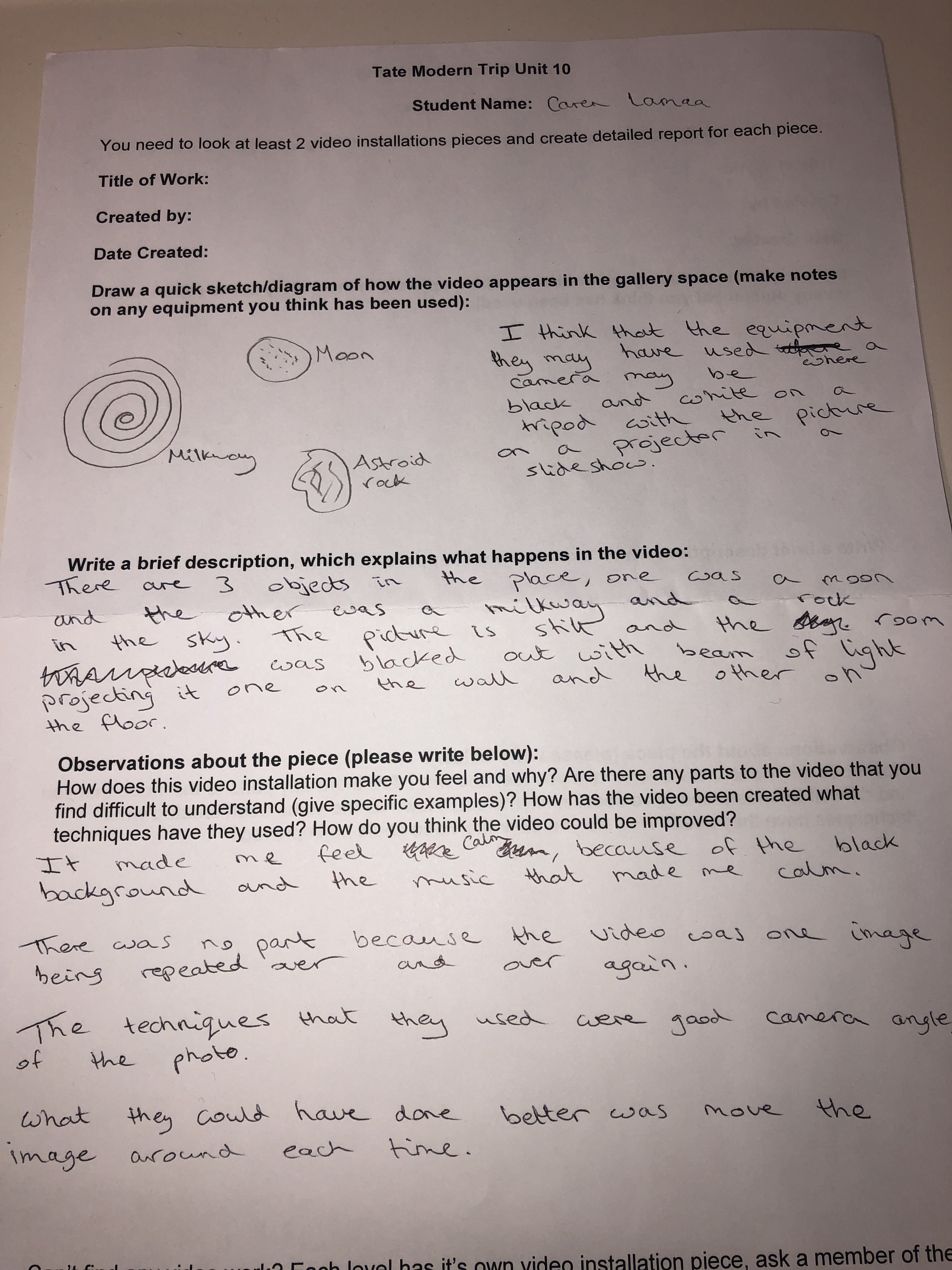
Unit 10 // Task 1 // Analysis and Research of Audience
In this report I shall attempt to understand the potential of video in an exhibition space as an art form. To do this I shall firstly cover what a video installation is then give a brief history of the form. Them I shall analyse two different video installation artists to enable me to answer the main objective of this report. Also, furthering my knowledge will help me make my own installation better.
Video installation is a contemporary art form that combines video technology with installation art, making use of all aspects of the surrounding environment to affect the audience.
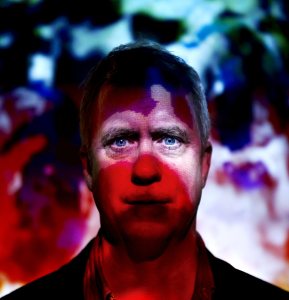
Artist: Tony Oursler
Tony Oursler is an American artist since the mid -1970’s. He is known for his video installation work that leaves a big effect on the human mind. His works always consists of sound, dark room environments, and language that is mixed with colourful constructed sculptural elements that make his videos seem unusual but also very effective and unique. Majority of his mesmerising installation works are dark/dull room environments with sound, video and language mixed with colourful constructed sculptural elements. He also does photography and collects images such as photographs (mainly), objects and books. His recent media installation work that consists of theatrical objects for example dolls or puppets that are covered with video productions and spoken texts, he has been producing video installations for the past twenty years.
He has exhibited widely around the world including Tate Liverpool, Centre Pompidou in Paris, The museum of contemporary art etc. His installation ‘The darkest colour infinitely amplified’ was presented at the Tate Modern and the Whitney Museum of American Art in 2000. His work was also shown at the 54th Venice Biennale in Glasstress. The target audience is teenagers/adults both female and male, however his work would be for people that are very interested in art.
Here is an example of one of his video installation work:
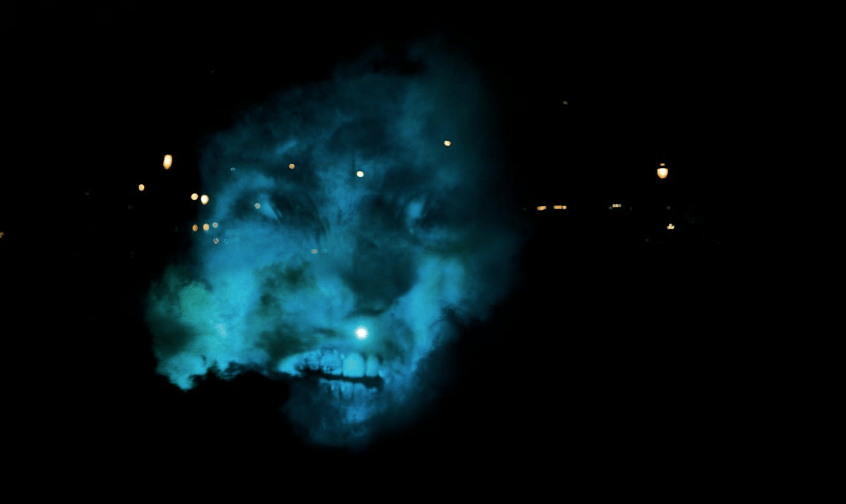
This is called The Influence Machine which is staged outdoors, it consists of seven video projections which all include their own audio track. This was made in 2000 and it was first shown in New York’s Madison Square Park and London’s Soho Square.
Artist: Bill Viola
Bill Viola was born in 1951, he is a contemporary video artist whose work always depends on sound, image technology and electronics. He focuses mainly on the idea behind the usual/normal human experiences that everyone can go through such as death, birth and the aspect of consciousness.
Majority of his work has themes that can be shown as life and death, being stressed or calm, light and dark or loud and quiet. He work can come across as unique as he has meaning and inspiration from his own deep interest in life and mystical traditions. His work can be split into three different types; visual, conceptual and an original combination of the two.
His work exhibits a painterly quality, the use of slow motion videos which engages the audience to sink into the image and to connect to the actual meaning to the work. This is what makes his work unique but also unusually accessible within a contemporary art context.
Here is an example of his work:
This video is shown as resurrection or what life is after death in his own way.
What I have learnt from writing this report is that I now have a better understanding of what video installation is as I have been researching in order to write about these artists. I also learnt a lot about the artists and how different their work is, this will benefit me when I do my own video installation as it has given me ideas to do my own.
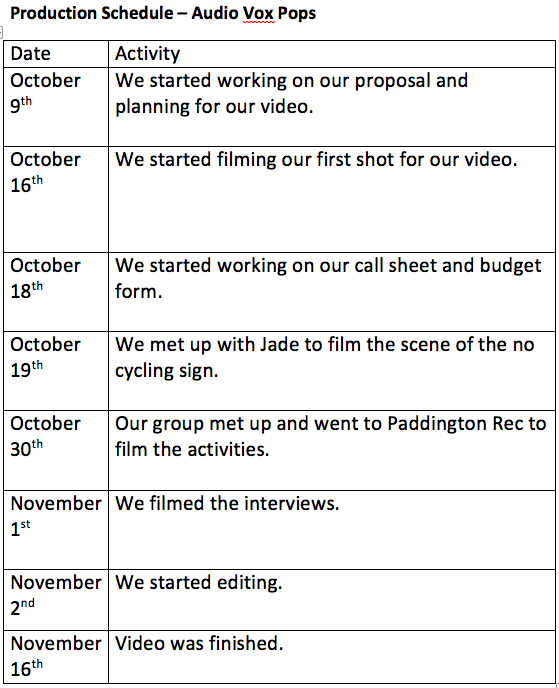
Unit 9 // Production schedule
 Caren's Blog